























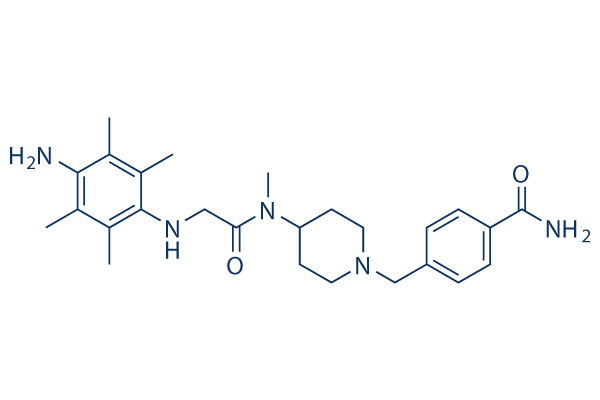
SUN11602
CAS No.: 704869-38-5
Capsid Cat: C13253
Please order through our authorised distributor.
Buy via Distributor2 years -80 in solvent
Description
SUN11602 is a small synthetic compound that mimics the neuroprotective activities of bFGF and activates key molecules in the FGF receptor-1-mitogen-activated protein kinase/extracellular signal-regulated kinase-1/2 kinase (FGFR-1-MEK/ERK) signaling pathway.
Biological Activity
| Targets |
|
|
|---|---|---|
| In vitro | Physiological actions of SUN11602 mimic several phenomena of the neuroprotection that is induced by bFGF. This compound plays a pivotal role in allowing primary cultured neurons to survive in adverse environments of glutamate toxicity and activating intracellular key molecules that are involved in the neuroprotective mechanisms. These actions are quite similar to those of bFGF. Such neuroprotective mechanisms are specific and distinctive to this compound and bFGF and differs clearly from those of the other growth factors that are investigated. But unlike bFGF, it can either directly or indirectly trigger the phosphorylation of the cytosolic domain of the FGFR without binding to the extracellular domain of the FGFR-1. This chemical demonstrates no cell proliferative activity of somatic cells, unlike bFGF. It significantly affects neuronal survival in adverse conditions through a FGFR1-mitogen-activated protein kinase/extracellular signal-regulated kinase-1/2 kinase (FGFR-1–MEK/ERK) signaling pathway. | |
| In vivo | In WT mice, SUN11602 and bFGF increase the levels of newly synthesized Calb in cerebrocortical neurons and suppress the glutamate-induced rise in intracellular Ca2+. This Ca2+-capturing ability of Calb allows the neurons to survive severe toxic conditions of glutamate. In contrast, Calb levels remain unchanged in Calb-/- mice after exposure to this compound or bFGF, and due to a loss of function of the gene, these neurons are no longer resistant to toxic conditions of glutamate. Neuroprotective activities of this chemical and FGF-2 are due to exogenously induced hyperexpression of CalB in hippocampal neurons. The pharmacokinetic properties of this compound appear to hold promise in terms of bioavailability (>65%) after oral administration in rodents (rats and mice) and dogs (beagles). |
Chemical Information & Solubility
| Formula | C26H37N5O2 | ||||||||||||||||||||
|---|---|---|---|---|---|---|---|---|---|---|---|---|---|---|---|---|---|---|---|---|---|
| Molecular Weight | 451.60 | ||||||||||||||||||||
| CAS No. | 704869-38-5 | ||||||||||||||||||||
| Solubility (25°C)* |
* <1 mg/mL means slightly soluble or insoluble. Capsid Bio tests the solubility of all compounds in-house; actual solubility may differ slightly from published values due to batch-to-batch variations. |
||||||||||||||||||||
| Preparing Stock Solutions |
|
||||||||||||||||||||
| Storage | 2 years -80 in solvent |
References
Additional information
| CAS Number | 704869-38-5 |
|---|---|
| Storage Conditions | 2 years -80 in solvent |
| Small Target | FGFR |
| Big Target | Protein Tyrosine Kinase |
| Capsid Category | C13253 |
| Selleck Category | S8192 |
| Supplier | Capsid |
Reviews
There are no reviews yet.