
























Simeprevir
CAS No.: 923604-59-5
Capsid Cat: C10634
Please order through our authorised distributor.
Buy via Distributor2 years -80 in solvent
Description
Simeprevir is a competitive, reversible, macrocyclic, noncovalent hepatitis C virus (HCV) NS3/4A protease inhibitor that acts directly against the hepatitis C virus. It has a medium inhibitory concentration (IC50) <13 nM for all HCV NS3/4A enzymes(genotypes 1a, 1b, 2, 4, 5, and 6), but has an IC50 value of 37 nM for genotype 3.
Biological Activity
| Targets |
|
|
|---|---|---|
| In vitro | Simeprevir exhibits potent inhibition on NS3/4A protease of genotypes 1a, 1b, 2, 4, 5, and 6, with a medium inhibitory concentration (IC50) <13 nM for all HCV NS3/4A enzymes tested. However, the IC50 for genotype 3 is 37 nM. In vitro, this compound is also an inhibitor of bilirubin transporters OATP1B1 and MRP2. It is a more potent inhibitor of OATP1B1 (IC50=720 nM), which is primarily responsible for transporting unconjugated bilirubin, than MRP2 (IC50 around 10,000 nM), primarily a conjugated bilirubin transporter. | |
| In vivo | In vivo, simeprevir has a relatively long absorption phase, reaching maximum concentration (Cmax) after 4-6 hours. It is extensively (99.9%) bound to plasma proteins, mainly to albumin. The absolute bioavailability is 44% after a single oral administration. In rats, the liver to blood ratio is 29:1, which means good distribution to the liver. For humans, in preclinical studies, the liver to plasma concentration ratio is really high (ratio of 39). The highest tissue/plasma AUC ratios are observed in the small intestine (ratio of 128). While tissue concentrations of this compound reach peak values within 4 hours postdosing, its concentrations in liver remain above the EC99 for up to 31 hours postdosing, and plasma concentrations are higher than the EC99 at 8 hours and around the EC50 at 24 hours postdosing. The AUC24h of this chemical is increased by 61%-69% when administered with food. It should therefore be taken with food. This compound is also a substrate and inhibitor of P-glycoprotein. It is metabolized by CYP3A4 and eliminated by biliary excretion. It is also an inhibitor of gut cytochrome 3A4 but not hepatic CYP3A4. |
Chemical Information & Solubility
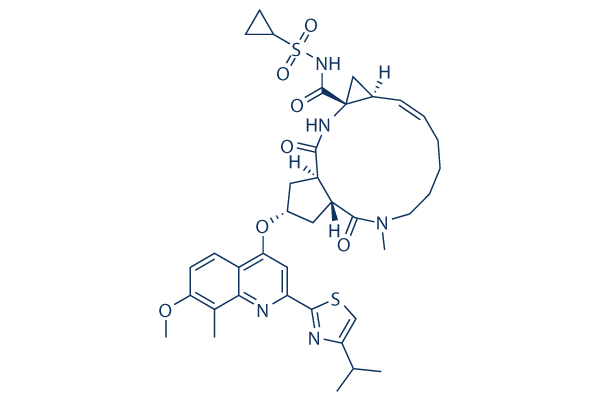
| Formula | C38H47N5O7S2 | ||||||||||||||||||||
|---|---|---|---|---|---|---|---|---|---|---|---|---|---|---|---|---|---|---|---|---|---|
| Molecular Weight | 749.94 | ||||||||||||||||||||
| CAS No. | 923604-59-5 | ||||||||||||||||||||
| Solubility (25°C)* |
* <1 mg/mL means slightly soluble or insoluble. Capsid Bio tests the solubility of all compounds in-house; actual solubility may differ slightly from published values due to batch-to-batch variations. |
||||||||||||||||||||
| Preparing Stock Solutions |
|
||||||||||||||||||||
| Storage | 2 years -80 in solvent |
Additional information
| CAS Number | 923604-59-5 |
|---|---|
| Synonyms | TMC435, TMC-435350 |
| Storage Conditions | 2 years -80 in solvent |
| Small Target | HCV Protease |
| Big Target | Proteases |
| Capsid Category | C10634 |
| Selleck Category | S5015 |
| Supplier | Capsid |
Reviews
There are no reviews yet.