
























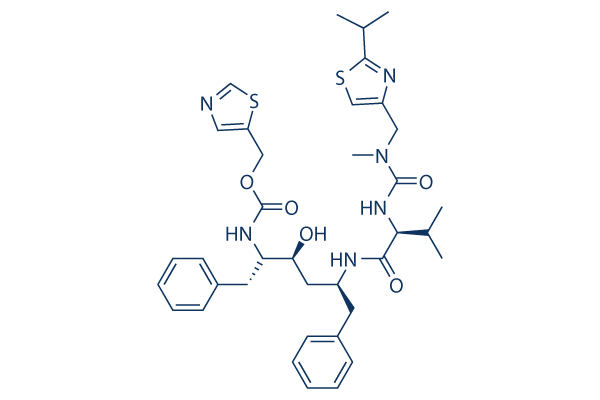
Ritonavir
CAS No.: 155213-67-5
Capsid Cat: C07593
Please order through our authorised distributor.
Buy via DistributorDescription
Biological Activity
| Targets |
|
||
|---|---|---|---|
| In vitro | Ritonavir is a very potent inhibitor of CYP3A4 mediated testosterone 6β-hydroxylation with mean Ki of 19 nM and also inhibits tolbutamide hydroxylation with IC50 of 4.2 μM. This compound is found to be a potent inhibitor of CYP3A-mediated biotransformations (nifedipine oxidation with IC50 of 0.07 mM, 17alpha-ethynylestradiol 2-hydroxylation with IC50 of 2 mM; terfenadine hydroxylation with IC50 of 0.14 mM). It is also found to be an inhibitor of the reactions mediated by CYP2D6 (IC50 = 2.5 mM) and CYP2C9/10 (IC50 = 8.0 mM). This agent results in an increase in cell viability in uninfected human PBMC cultures. It markedly decreases the susceptibility of PBMCs to apoptosis correlated with lower levels of caspase-1 expression, decreases in annexin V staining, and reduces caspase-3 activity in uninfected human PBMC cultures. The compound inhibits induction of tumor necrosis factor (TNF) production by PBMCs and monocytes in a time- and dose-dependent manner at nontoxic concentrations. It inhibits p-glycoprotein-mediated extrusion of saquinavir with an IC50 of 0.2 μM, indicating a high affinity of ritonavir for p-glycoprotein. This chemical inhibits human liver microsomal metabolism of ABT-378 potently with Ki of 13 nM. When combined with ABT-378 (at 3:1 and 29:1 ratios), it inhibits CYP3A (IC50 = 1.1 and 4.6 μM), albeit less potently than Ritonavir (IC50 = 0.14 μM). |
Chemical Information & Solubility
| Formula | C37H48N6O5S2 | ||||||||||||||||||||
|---|---|---|---|---|---|---|---|---|---|---|---|---|---|---|---|---|---|---|---|---|---|
| Molecular Weight | 720.94 | ||||||||||||||||||||
| CAS No. | 155213-67-5 | ||||||||||||||||||||
| Solubility (25°C)* |
* <1 mg/mL means slightly soluble or insoluble. Capsid Bio tests the solubility of all compounds in-house; actual solubility may differ slightly from published values due to batch-to-batch variations. |
||||||||||||||||||||
| Preparing Stock Solutions |
|
||||||||||||||||||||
| Storage | 2 years -80 in solvent |
References
Additional information
| CAS Number | 155213-67-5 |
|---|---|
| Synonyms | ABT-538,A 84538, RTV |
| Storage Conditions | 2 years -80 in solvent |
| Small Target | HIV Protease |
| Big Target | Proteases |
| Capsid Category | C07593 |
| Selleck Category | S1185 |
| Supplier | Capsid | Selleck |
Reviews
There are no reviews yet.