
























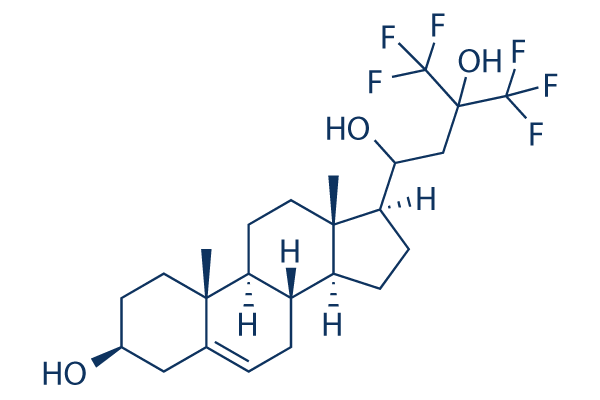
NSC12
CAS No.: 102586-30-1
Capsid Cat: C13070
Please order through our authorised distributor.
Buy via Distributor2 years -80 in solvent
Description
NSC12 (NSC 172285) is an orally available pan-FGF trap able to inhibit FGF2/FGFR interaction and endowed with promising antitumor activity.
Biological Activity
| Targets |
|
||||||||||||||||||||
|---|---|---|---|---|---|---|---|---|---|---|---|---|---|---|---|---|---|---|---|---|---|
| In vitro | NSC12 inhibits FGF-dependent tumor growth, angiogenesis, and metastases. This compound does not affect FGF2/heparin interaction, whereas it inhibits the binding of FGF2 to the immobilized receptor (ID50 ∼30 μM). It interferes with FGF2/FGFR1 interaction without affecting the ability of the growth factor to interact with heparin or HSPGs. This chemical also binds immobilized FGF3, FGF4, FGF6, FGF8, FGF16, FGF18, FGF20, and FGF22 with Kd values ranging between ∼16 and ∼120 μM. It may act as a multi-FGF trap by interacting with all members of the canonical FGF subfamilies. This compound hampers FGF23-mediated FGFR1 activation in Klotho-expressing Chinese hamster ovary (CHO) cells. Treatment with it causes the reduction of the S phase of the cell cycle in all tumor cell lines but LLC cells, in which an accumulation in the S phase is observed. It inhibits FGFR1, FGFR2, FGFR3, and FGFR4 phosphorylation in CHO cell transfectants. This inhibitor reduces the proliferation of various FGF-dependent murine and human cancer cell lines with no inhibitory effect on HCC827 cancer cells that harbor a tumor-driving mutation of the EGFR TK domain and on FGF-independent cancer cell lines. | ||||||||||||||||||||
| In vivo | Parenteral and oral delivery of NSC12 inhibits FGFR activation, tumor growth, angiogenesis, and metastasis in FGF-dependent murine and human tumor models. This compound causes a significant decrease of tumor weight, tumor cell FGFR1 phosphorylation and proliferation, and tumor CD31+ neovascularization at all the doses tested in the animal models. |
Chemical Information & Solubility
| Formula | C24H34F6O3 | ||||||||||||||||||||
|---|---|---|---|---|---|---|---|---|---|---|---|---|---|---|---|---|---|---|---|---|---|
| Molecular Weight | 484.52 | ||||||||||||||||||||
| CAS No. | 102586-30-1 | ||||||||||||||||||||
| Solubility (25°C)* |
* <1 mg/mL means slightly soluble or insoluble. Capsid Bio tests the solubility of all compounds in-house; actual solubility may differ slightly from published values due to batch-to-batch variations. |
||||||||||||||||||||
| Preparing Stock Solutions |
|
||||||||||||||||||||
| Storage | 2 years -80 in solvent |
References
Additional information
| CAS Number | 102586-30-1 |
|---|---|
| Synonyms | NSC 172285 |
| Storage Conditions | 2 years -80 in solvent |
| Small Target | FGFR |
| Big Target | Protein Tyrosine Kinase |
| Capsid Category | C13070 |
| Selleck Category | S7940 |
| Supplier | Capsid |
Reviews
There are no reviews yet.