
























FCCP
CAS No.: 370-86-5
Capsid Cat: C13310
Please order through our authorised distributor.
Buy via DistributorDescription
Biological Activity
| Targets |
|
||
|---|---|---|---|
| In vitro | FCCP treatment induces a very rapid 2-fold increase in intracellular Ca2+ concentration that is accompanied by a strong protein synthesis rate inhibition. The translation inhibition correlates with an increased phosphorylation of the α subunit of eIF2 (eIF2α) and a 1.7-fold increase in the double-stranded RNA-dependent protein kinase activity. This compound also mildly decreases ATP and reactive oxygen species levels. It increases the expression of mitochondrial genes such as Tfam and COXIV while inducing morphological features of quiescent mouse HSCs and abrogating TGF-β signal transduction. |
||
| In vivo | FCCP significantly reduces mitochondrial membrane potential and ATP production in 8-cell mouse embryos and the number of inner cell mass cells within blastocysts with unchanged blastocyst development. This perturbed embryonic mitochondrial function is concomitant with reduced birth weight in female offspring following embryo transfer, which persists until weaning. Although this compound-treated males also exhibits reduced glucose tolerance as female, but their insulin sensitivity and adiposity gain between 4 and 14 weeks is unchanged. Reducing mitochondrial function and, thus, decreasing ATP output in the precompacting embryo can influence offspring phenotype. |
Chemical Information & Solubility
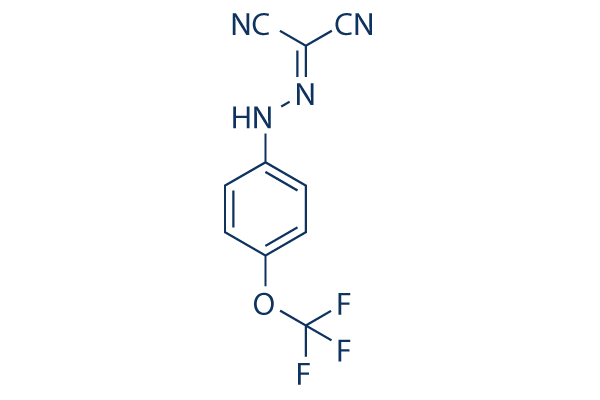
| Formula | C10H5F3N4O | ||||||||||||||||||||
|---|---|---|---|---|---|---|---|---|---|---|---|---|---|---|---|---|---|---|---|---|---|
| Molecular Weight | 254.17 | ||||||||||||||||||||
| CAS No. | 370-86-5 | ||||||||||||||||||||
| Solubility (25°C)* |
* <1 mg/mL means slightly soluble or insoluble. Capsid Bio tests the solubility of all compounds in-house; actual solubility may differ slightly from published values due to batch-to-batch variations. |
||||||||||||||||||||
| Preparing Stock Solutions |
|
||||||||||||||||||||
| Storage | 2 years -80 in solvent |
Additional information
| CAS Number | 370-86-5 |
|---|---|
| Synonyms | Trifluoromethoxy carbonylcyanide phenylhydrazone, Carbonyl cyanide 4-(trifluoromethoxy)phenylhydrazone |
| Storage Conditions | 2 years -80 in solvent |
| Small Target | ATPase |
| Big Target | Transmembrane Transporters |
| Capsid Category | C13310 |
| Selleck Category | S8276 |
| Supplier | Capsid |
Reviews
There are no reviews yet.