
























Eprenetapopt (APR-246)
CAS No.: 5291-32-7
Capsid Cat: C12900
Please order through our authorised distributor.
Buy via DistributorDescription
Biological Activity
| Targets |
|
|
|---|---|---|
| In vitro | Eprenetapopt (APR-246), also known as PRIMA-1MET, is the first clinical-stage compound that reactivates mutant p53 and induces apoptosis. It is a prodrug that is converted to the active compound methylene quinuclidinone (MQ), a Michael acceptor that binds to cysteine residues in mutant p53 and restores its wild-type conformation. This compound not only reactivates p53 but also decreases intracellular glutathione levels in a dose-dependent manner. It can trigger apoptosis in a p53-independent manner by inducing ROS and endoplasmic reticulum (ER) stress and by inhibiting thioredoxin reductase 1 (TrxR1). It was also reported that APR-246 induces cell death in myeloma cells independently of p53 status by impairing the GSH/ROS balance. PRIMA-1Met/APR-246 efficiently inhibited the growth of the SCLC cell lines expressing mutant p53 in vitro and induced apoptosis, associated with increased fraction of cells with fragmented DNA, caspase-3 activation, PARP cleavage, Bax and Noxa upregulation and Bcl-2 downregulation in the cells. |
|
| In vivo | In a Phase I/II clinical dose-finding study on hematological malignancies and prostate cancer, Eprenetapopt (APR-246) showed a good safety profile, and both clinical and p53-dependent biological responses were observed. It is well tolerated in animal studies, and single treatment with this compound inhibits tumor growth by 21% in mice bearing the aggressively growing A2780-CP20 tumor xenografts. |
Chemical Information & Solubility
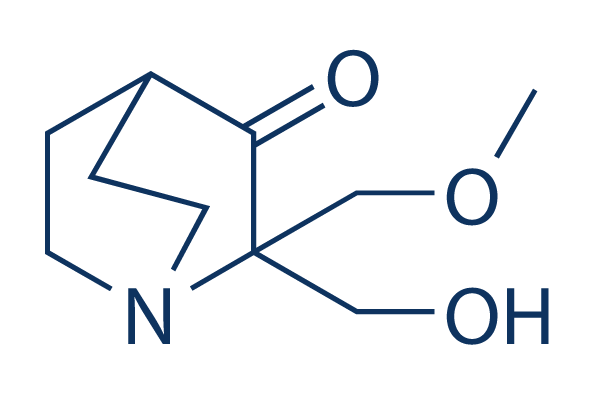
| Formula | C10H17NO3 | ||||||||||||||||||||
|---|---|---|---|---|---|---|---|---|---|---|---|---|---|---|---|---|---|---|---|---|---|
| Molecular Weight | 199.25 | ||||||||||||||||||||
| CAS No. | 5291-32-7 | ||||||||||||||||||||
| Solubility (25°C)* |
* <1 mg/mL means slightly soluble or insoluble. Capsid Bio tests the solubility of all compounds in-house; actual solubility may differ slightly from published values due to batch-to-batch variations. |
||||||||||||||||||||
| Preparing Stock Solutions |
|
||||||||||||||||||||
| Storage | 2 years -80 in solvent |
References
Additional information
| CAS Number | 5291-32-7 |
|---|---|
| Synonyms | PRIMA-1MET |
| Storage Conditions | 2 years -80 in solvent |
| Small Target | p53 |
| Big Target | Apoptosis |
| Capsid Category | C12900 |
| Selleck Category | S7724 |
| Supplier | Capsid |
Reviews
There are no reviews yet.