
























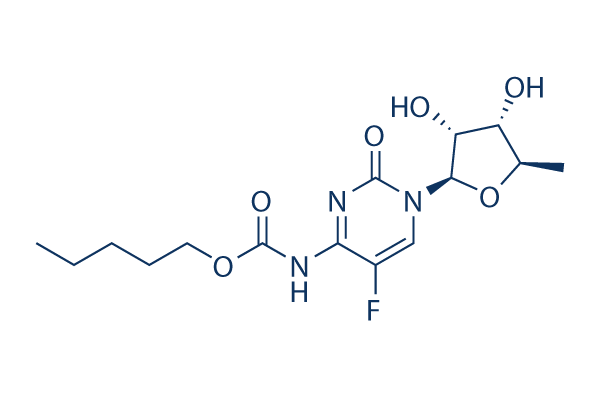
Capecitabine
CAS No.: 154361-50-9
Capsid Cat: C07566
Please order through our authorised distributor.
Buy via Distributor2 years -80 in solvent
Description
Capecitabine is a tumor-selective fluoropyrimidine carbamate, which achieves higher intratumoral 5-FU level with lower toxicity than 5-FU. Capecitabine treatment of HCT-15 cells causes condensation of DNA and induces apoptosis.
Biological Activity
| Targets |
|
|
|---|---|---|
| In vitro | Both LS174T WT and LS174T-c2 cells show significantly greater sensitivity to Capecitabine when cultivated in the same plates as HepG2 hepatoma with IC50 values of 890 and 630 μM in LS174T WT alone and cultivated with HepG2, respectively. In addition, for the LS174T-C2 subline, the IC50 falls from 330 ± 4 down to 89 ± 6 μm when cultivated in the same plates as hepatoma cells. Furthermore, this compound induces apoptosis in a Fas-dependent manner, and shows a 7-fold higher cytotoxicity and markedly stronger apoptotic potential in thymidine phosphorylase (TP)-transfected LS174T-c2 cells. | |
| In vivo | In the human cancer xenograft models studied, Capecitabine is more effective in a wider dose range and has a broader spectrum of antitumor activity than 5-FU, UFT or its intermediate metabolite 5'-DFUR, which can be correlated with tumor dThdPase levels. This compound inhibits tumor growth and metastatic recurrence after resection of human hepatocellular carcinoma (HCC) in highly metastatic nude mice model which is attributed to the high expression of platelet-derived endothelial cell growth factor in tumors. | |
| Mechanism of Action | A tumor-selective fluoropyrimidine carbamate. |
Chemical Information & Solubility
| Formula | C15H22FN3O6 | ||||||||||||||||||||
|---|---|---|---|---|---|---|---|---|---|---|---|---|---|---|---|---|---|---|---|---|---|
| Molecular Weight | 359.35 | ||||||||||||||||||||
| CAS No. | 154361-50-9 | ||||||||||||||||||||
| Solubility (25°C)* |
* <1 mg/mL means slightly soluble or insoluble. Capsid Bio tests the solubility of all compounds in-house; actual solubility may differ slightly from published values due to batch-to-batch variations. |
||||||||||||||||||||
| Preparing Stock Solutions |
|
||||||||||||||||||||
| Storage | 2 years -80 in solvent |
Additional information
| CAS Number | 154361-50-9 |
|---|---|
| Synonyms | RO 09-1978 |
| Storage Conditions | 2 years -80 in solvent |
| Small Target | DNA/RNA Synthesis |
| Big Target | Cell Cycle |
| Capsid Category | C07566 |
| Selleck Category | S1156 |
| Supplier | Capsid | Selleck |
Reviews
There are no reviews yet.