
























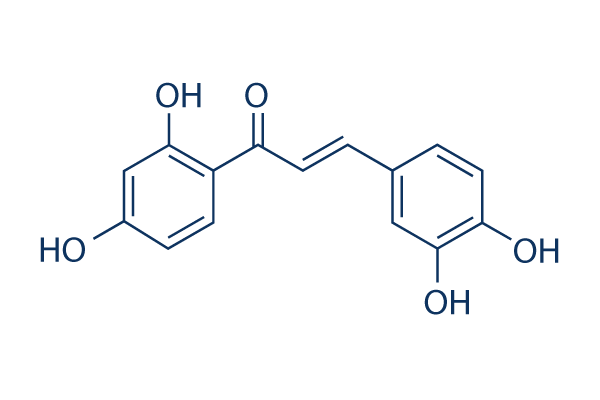
Butein
CAS No.: 487-52-5
Capsid Cat: C13142
Please order through our authorised distributor.
Buy via Distributor2 years -80 in solvent
Description
Butein, a plant polyphenol isolated from Rhus verniciflua, is able to inhibit the activation of protein tyrosine kinase, NF-κB and STAT3, also inhibits EGFR.
Biological Activity
| Targets |
|
|
|---|---|---|
| In vitro | Butein inhibits the epidermal growth factor (EGF)-stimulated auto-phosphotyrosine level of EGF receptor in HepG2 cells, and also inhibits tyrosine-specific protein kinase activities of EGF receptor and p60c-src with IC50 of 65 μM in vitro. The inhibition is competitive to ATP and non-competitive to the phosphate acceptor, poly (Glu, Ala, Tyr) 6:3:1 for EGF receptor tyrosine kinase. In contrast, this compound non-significantly inhibits the activities of serine- and threonine-specific protein kinases such as PKC or PKA. This chemical inhibits Nuclear Factor(NF)-κB and NF-κB-regulated gene expression through direct inhibition of IκBα Kinase β on Cysteine 179 Residue. It (10 μM) inhibits over 90% iNOS and COX-2 expression, as well as nitrite and TNF-α production in LPS-stimulated RAW 264.7 cells. This compound (10 μM) inhibits LPS-induced DNA binding activity of NF-κB, which is mediated through inhibition of the degradation of inhibitory factor-κB and phosphorylation of Erk1/2 MAP kinase, as well as increases binding of the osteopontin a vb3 integrin receptor. It (20 μM) treatment induces morphologic changes of bladder cancer cells BLS(M) from elongated morphology to rounded epithelial-like cells, accompanied by downregulation of vimentin, and gaining of E-cadherin compared to untreated control cells, indicating the reversal of mesenchymal-like phenotype. This chemical (20 μM) suppresses motility and invasion capacity of BLS(M) cells, and reverts EMT-like phenotype induced by TNF-α, through the ERK1/2 and NF-κB signaling pathways. It inhibits the constitutive activation of STAT3 in HepG2 cells in a dose-dependent manner, with maximum inhibition occurring at 50 μM, mediated through the inhibition of activation of upstream kinases c-Src and Janus-activated kinase2. This compound (50 μM) also could completely inhibit IL-6-induced STAT3 phosphorylation in SNU-387 cells. It downregulates the expression of cyclin D1, Bcl-2, Bcl-xL, survivin, and VEGF, markers of STAT3 activation. This chemical (50 μM) significantly enhance the apoptotic effects of doxorubicin from 18% to 55% and of paclitaxel from 15% to 42%. It is as a powerful antioxidant against lipid and LDL peroxidation. This compound inhibits iron-induced lipid peroxidation in rat brain homogenate with an IC50 of 3.3 μM. It is as potent α-tocopherol in reducing the stable free radical diphenyl-2-picrylhydrazyl (DPPH) with IC0.2 of 9.2 μM. This chemical also inhibits the activity of xanthine oxidase with an IC50 of 5.9 μM. It scavenges the peroxyl radical derived from 2,2-azobis(2-amidinopropane) dihydrochloride (AAPH) in aqueous phase. Furthermore, this compound inhibits copper-catalyzed oxidation of human low-density lipoprotein (LDL) in a concentration-dependent manner. It is a chelator of ferrous and copper ions. | |
| In vivo | Butein at 2 mg/kg induces significant inhibition of hepatocellular tumor growth compared with the corn oil-treated controls. At necropsy on day 22 after initial treatment, there is more than 2-fold decrease in tumor growth in this compound-treated group (mean relativetumor burden, 3.90) compared with the control group (8.46), associated with reduced constitutive p-STAT3 (9% vs 81% of vehicle group), Bcl-2 levels (26% vs 96% of vehicle group), and increased caspase-3 level (98% vs 21% of vehicle group) in HCC tumor tissues. This compound shows antifibrogenic activity. It (25 mg/kg/day) reduces serum AST and ALT activation to 35% and 69%, respectively, of control CCl4-induced rat levels. This chemical (25 mg/kg/day) reduces liver hydroxyproline contents and TBAR4 concentration to 54% and 54%, respectively. α1(I) collagen and TIMP-1 expression in this compound-treated rats is 28% and 20.3% compared with the values for the respective CCl4-treated control. |
Chemical Information & Solubility
| Formula | C15H12O5 | ||||||||||||||||||||
|---|---|---|---|---|---|---|---|---|---|---|---|---|---|---|---|---|---|---|---|---|---|
| Molecular Weight | 272.25 | ||||||||||||||||||||
| CAS No. | 487-52-5 | ||||||||||||||||||||
| Solubility (25°C)* |
* <1 mg/mL means slightly soluble or insoluble. Capsid Bio tests the solubility of all compounds in-house; actual solubility may differ slightly from published values due to batch-to-batch variations. |
||||||||||||||||||||
| Preparing Stock Solutions |
|
||||||||||||||||||||
| Storage | 2 years -80 in solvent |
References
Additional information
| CAS Number | 487-52-5 |
|---|---|
| Storage Conditions | 2 years -80 in solvent |
| Small Target | EGFR |
| Big Target | Protein Tyrosine Kinase |
| Capsid Category | C13142 |
| Selleck Category | S8036 |
| Supplier | Capsid |
Reviews
There are no reviews yet.