
























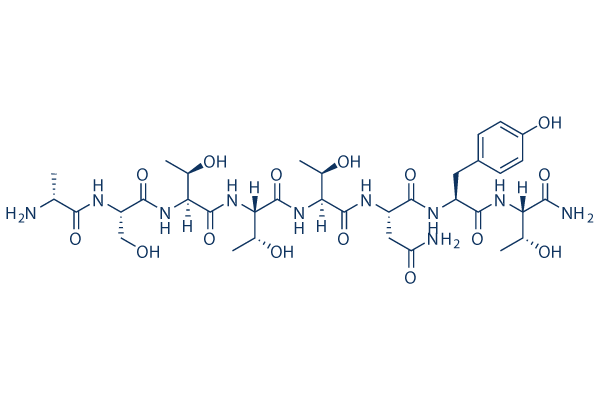
Adaptavir (DAPTA)
CAS No.: 106362-34-9
Capsid Cat: C13453
Please order through our authorised distributor.
Buy via Distributor2 years -80 in solvent
Description
Adaptavir (DAPTA, D-Ala-peptide T-amide, peptide T) is a water soluble potent, selective CCR5 antagonist which potently inhibits specific CD4-dependent binding of gp120 Bal (IC50 = 0.06 nM) and CM235 (IC50 = 0.32 nM) to CCR5.
Biological Activity
| Targets |
|
||||
|---|---|---|---|---|---|
| In vitro | Adaptavir (DAPTA) is a non-toxic experimental antiviral entry inhibitor that potently inhibits specific CD4-dependent binding of gp120 Bal (IC50 = 0.06 nM) and CM235 (IC50 = 0.32 nM) to CCR5. In co-immunoprecipitation studies, this compound (1 nM) blocks formation of the gp120/sCD4 complex with CCR5. Confocal microscopic studies of direct FITC-DAPTA binding to CCR5+, but not CCR5−, cells show that CCR5 is a DAPTA receptor. It is an antagonist of CCR5-mediated chemotaxis and is most effective as an antiviral agent primarily against R5-tropic HIV-1 isolates, with reduced or absent effect for X4-tropic laboratory isolates. DAPTA does not inhibit fusion in typical assays, which use high local concentrations of virus and cells. The Th2 cytokines IL-4, IL-10,and IL-13, are increased by this compound and induce a potent virostatic state in infected macrophages in vitro, as well as inhibit production of the proinflammatory cytokines IL-1 and TNFα, which upregulate virus expression. Thus the elevation of Th2 cytokines by DAPTA treatment would favor less macrophage viral replication. | ||||
| In vivo | Following DAPTA treatment, the levels of inflammatory cytokines IL-1, IL-6, and TNFα decrease in plasma. This compound also prevents the neuronal cell death associated with gpl20 and prevents gpl20-associated neural deficits in vivo. |
Chemical Information & Solubility
| Formula | C35H56N10O15 | ||||||||||||||||||||
|---|---|---|---|---|---|---|---|---|---|---|---|---|---|---|---|---|---|---|---|---|---|
| Molecular Weight | 856.88 | ||||||||||||||||||||
| CAS No. | 106362-34-9 | ||||||||||||||||||||
| Solubility (25°C)* |
* <1 mg/mL means slightly soluble or insoluble. Capsid Bio tests the solubility of all compounds in-house; actual solubility may differ slightly from published values due to batch-to-batch variations. |
||||||||||||||||||||
| Preparing Stock Solutions |
|
||||||||||||||||||||
| Storage | 2 years -80 in solvent |
Additional information
| CAS Number | 106362-34-9 |
|---|---|
| Synonyms | D-Ala-peptide T-amide, peptide T |
| Storage Conditions | 2 years -80 in solvent |
| Small Target | CCR |
| Big Target | GPCR & G Protein |
| Capsid Category | C13453 |
| Selleck Category | S8501 |
| Supplier | Capsid |
Reviews
There are no reviews yet.