
























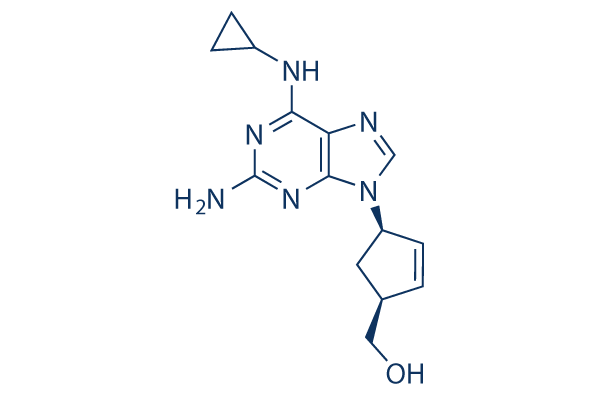
Abacavir
CAS No.: 136470-78-5
Capsid Cat: C10813
Please order through our authorised distributor.
Buy via Distributor2 years -80 in solvent
Description
Abacavir is a powerful nucleoside analog reverse transcriptase inhibitor (NRTI) used to treat HIV and AIDS.
Biological Activity
| Targets |
|
|
|---|---|---|
| In vitro | Abacavir (ABC) exhibits potent in vitro antiviral activity against wild-type HIV-1 (IC50 4.0 μM, MT-4 cells). This compound induces chromosomal DSBs and thereby kills ATL cells but not non-HTLV-1-infected cells. Once it is incorporated into the cells, it is phosphorylated in a unique stepwise anabolism to be converted to the triphosphated guanine analog carbovir (CBV) and then incorporated into host chromosomal DNA by replicative DNA polymerases, leading to premature termination of DNA replication, collapse of the replication fork, and DSB formation. This chemical induces S/G2-phase arrest and apoptosis in ED-40515(−) cells, but not in Jurkat cells. | |
| In vivo | Abacavir efficiently inhibits the growth of ATL cell xenografts in NOD/SCID mice. In adults, this compound is rapidly absorbed after oral administration, with peak concentrations occurring 0.63-1 hour after dosing. The absolute bioavailability of abacavir is approximately 83%. Its pharmacokinetics are linear and doseproportional over the range of 300-1200 mg/day. The apparent volume of distribution after intravenous administration is approximately 0.86 ± 0.15 L/kg, suggesting that it is distributed to extravascular spaces. Binding to plasma proteins is about 50% and is independent of the plasma abacavir concentration. This chemical is extensively metabolized by the liver; less than 2% is excreted as unchanged drug in the urine. It is primarily metabolized via two pathways, uridine diphosphate glucuronyltransferase and alcohol dehydrogenase, resulting in the inactive glucuronide metabolite and the inactive carboxylate metabolite. The terminal elimination half-life is approximately 1.5 hours. The antiviral effect is due to its intracellular anabolite, carbovirtriphosphate (CBV-TP). This compound is not significantly metabolized by cytochrome P450 (CYP) enzymes, nor does it inhibit these enzymes. |
Chemical Information & Solubility
| Formula | C14H18N6O | ||||||||||||||||||||
|---|---|---|---|---|---|---|---|---|---|---|---|---|---|---|---|---|---|---|---|---|---|
| Molecular Weight | 286.33 | ||||||||||||||||||||
| CAS No. | 136470-78-5 | ||||||||||||||||||||
| Solubility (25°C)* |
* <1 mg/mL means slightly soluble or insoluble. Capsid Bio tests the solubility of all compounds in-house; actual solubility may differ slightly from published values due to batch-to-batch variations. |
||||||||||||||||||||
| Preparing Stock Solutions |
|
||||||||||||||||||||
| Storage | 2 years -80 in solvent |
Additional information
| CAS Number | 136470-78-5 |
|---|---|
| Synonyms | 1592U89 |
| Storage Conditions | 2 years -80 in solvent |
| Small Target | Reverse Transcriptase |
| Big Target | Microbiology |
| Capsid Category | C10813 |
| Selleck Category | S5215 |
| Supplier | Capsid |
Reviews
There are no reviews yet.